
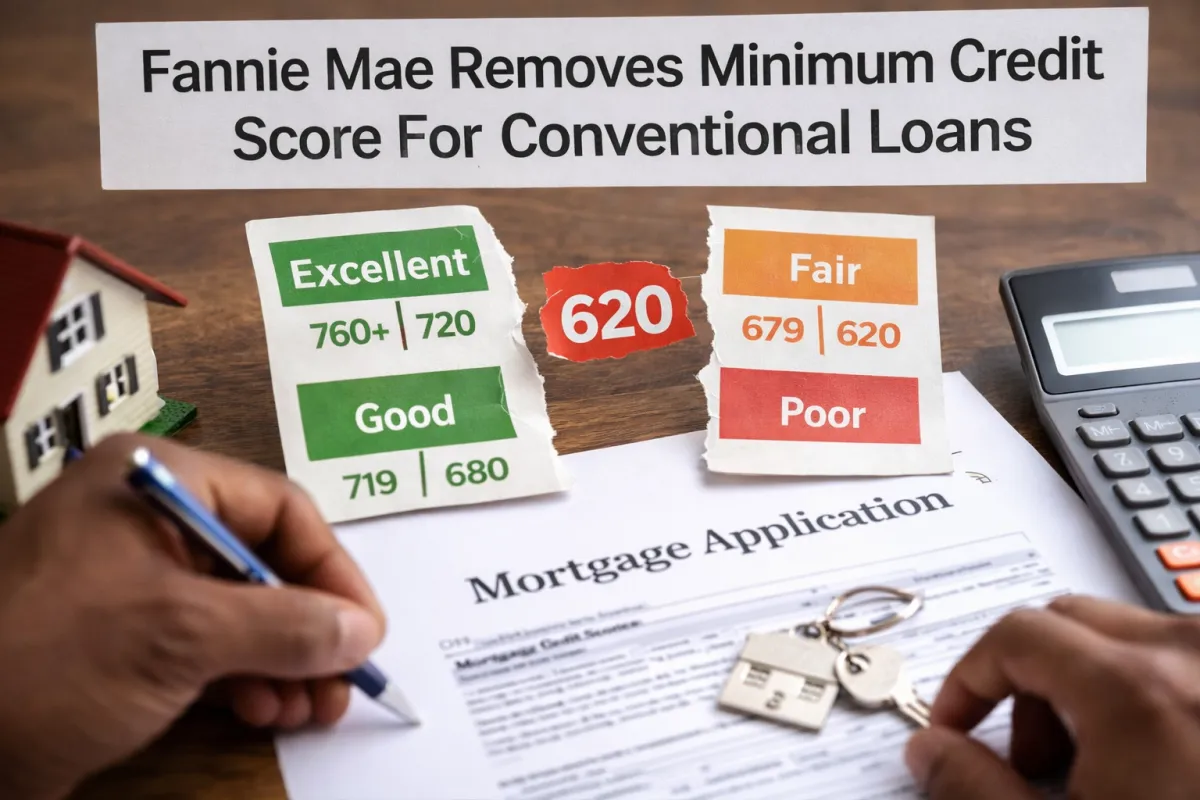
Fannie Mae Removes the Minimum Credit Score Requirement

What This Really Means for Homebuyers
Every so often, a change happens in the mortgage world that doesn’t grab big headlines but quietly shifts what’s possible for buyers. This is one of those moments.
In late 2025, Fannie Mae removed the minimum credit score requirement tied to conventional loans. For years, that 620 number felt like a hard stop. If your score was below it, most buyers assumed conventional financing simply wasn’t an option and never explored it further.
That assumption no longer holds the same weight.
Let’s break down what actually changed, who this helps, and what buyers should understand before jumping to conclusions.
What Changed (And What Didn’t)
The biggest update is simple on paper: there is no longer a hard minimum credit score baked into Fannie Mae’s conventional loan guidelines.
What does that mean in real life?
One number no longer automatically shuts the door.
But context matters.
This does not mean lenders approve everyone. It also doesn’t mean credit score suddenly stopped mattering. Lenders still set their own standards, and higher scores still unlock better interest rates and loan terms.
The key difference is flexibility. Instead of an automatic “no” at 619 or below, lenders can now evaluate the full picture before making a decision.
Who This Change Helps Most
This update creates new conversations for buyers who previously felt stuck.
It may benefit:
Buyers with credit scores below 620
Buyers actively rebuilding their credit
Buyers comparing FHA loans versus conventional financing
Why does this matter? Because conventional loans can offer advantages for the right borrower, including private mortgage insurance (PMI) that can be removed later. Over time, that can reduce long-term housing costs compared to some alternatives.
That said, access does not equal affordability. Your credit score still plays a role in the math. A lower score can mean a higher rate, different down payment requirements, or additional conditions.
The opportunity isn’t about shortcuts. It’s about having options again.
What Lenders Actually Look At
One of the biggest misconceptions in lending is that approval comes down to a single number. Credit score is important, but it’s only one piece of a much larger puzzle.
Lenders also review:
Income and job stability
Debt-to-income ratio
Cash reserves and savings
Payment patterns over time, not just the score itself
Someone with a lower score but strong income, manageable debt, and consistent payment history may present less risk than someone with a higher score and shaky finances.
That’s why this change matters. It allows lenders to assess borrowers as complete financial profiles instead of filtering them out too early.
Should You Apply If Your Score Is Under 620?
If your score is under 620, this update doesn’t guarantee approval, but it absolutely opens the door to a conversation.
There are still important trade-offs to consider:
Lower scores typically come with higher interest rates
Down payment requirements may vary
FHA and conventional loans each have their own pros and cons
For some buyers, FHA will still be the better fit. For others, conventional financing may now be worth revisiting, especially when removable PMI is part of the equation.
The smartest move is not guessing. It’s comparing options side by side with real numbers.
👉 The Bigger Takeaway
The biggest mistake I see buyers make is ruling themselves out before getting clarity.
More flexibility doesn’t mean more pressure to buy. It means more control when you understand how to use it. This update gives buyers the chance to ask better questions, explore more paths, and make decisions based on facts instead of assumptions.
If you’ve been unsure where you stand, this is your sign to stop guessing and start getting real answers. The door isn’t wide open for everyone, but it’s no longer locked by a single number either.
And sometimes, that makes all the difference.
Angela Smith | Florida Wholesale Mortgage (NMLS 2180491)
239-980-6669
[email protected]
NMLS #2666684
👉 Contact Florida Wholesale Mortgage
“Let’s Find The Perfect Loan.”